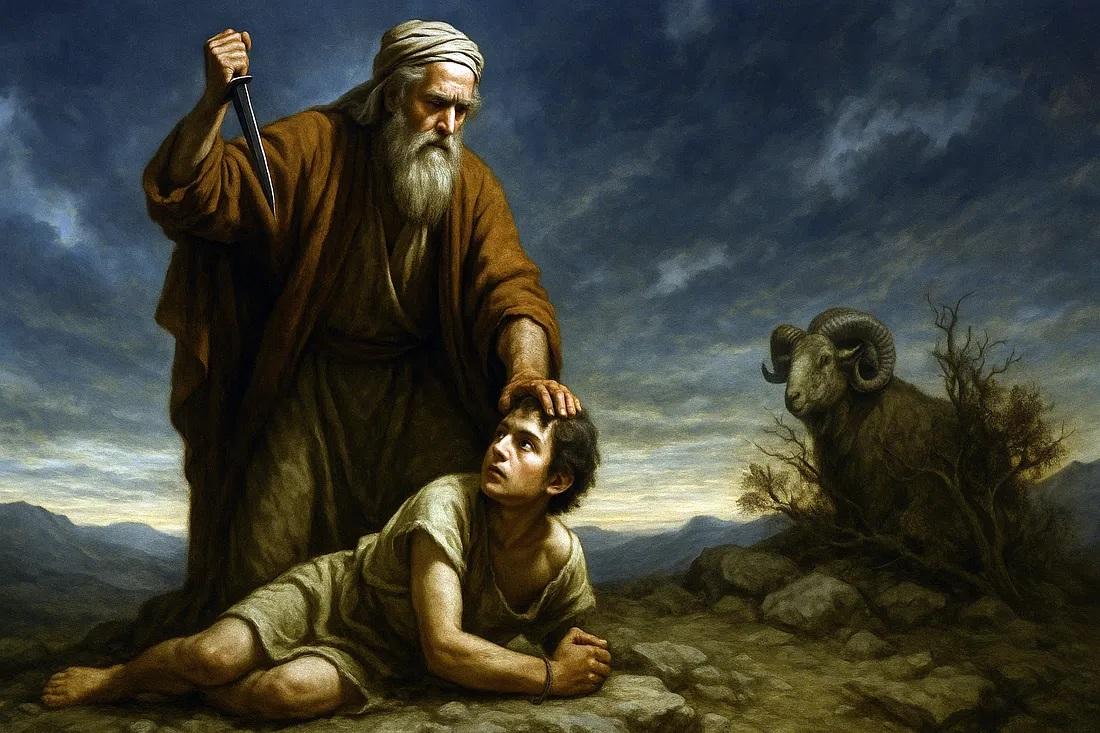
The story of Abraham offering his son as a sacrifice is one of the most debated biblical narratives throughout history, particularly from an ethical and apologetic perspective. When readers encounter the passage in the Book of Genesis where God commands Abraham to offer his son as a burnt offering, an immediate question arises: Does God require human sacrifice? And how can such a command be reconciled with the image of a loving and righteous God? Furthermore, what is the relationship between Abraham’s offering of his son and the broader biblical concept of redemption?
These questions cannot be addressed superficially or emotionally. They require a careful historical, theological, and apologetic reading that uncovers the deeper purpose of the narrative and the nature of the divine revelation within it.
First: The Historical and Religious Background of the Story
Abraham lived in a world where human sacrifice was known among several ancient civilizations, particularly among the Canaanite peoples and surrounding cultures. In some pagan religions, offering children to the gods was believed to secure divine favor, avert wrath, or bring prosperity. Thus, the idea of “offering one’s son” would not have appeared entirely foreign within the ancient Near Eastern context.
Yet the striking reality is that the Bible, as a whole, firmly rejects human sacrifice. In numerous passages, God condemns such practices and describes them as abominations. Therefore, the story of Abraham cannot be interpreted as an endorsement of human sacrifice, but rather as a revelation that ultimately repudiates it.
Second: Did God Truly Intend Isaac to Be Sacrificed?
A careful reading of the text makes it clear that God never allowed the sacrifice to be completed. Abraham was stopped before carrying out the act, and God provided a ram in place of Isaac. This conclusion is not a secondary detail; it is the very heart and message of the narrative.
Had the divine intention been to endorse human sacrifice, Isaac would indeed have died. Instead, the opposite occurs: God halts the human sacrifice and provides a substitute.
This reveals an important apologetic point: the story does not glorify the killing of children. Rather, it demonstrates that God does not desire the human being as the sacrifice; instead, He Himself provides the substitute.
Third: A Test of Faith, Not an Expression of Cruelty
The narrative begins with a crucial statement: “God tested Abraham.” The event is therefore presented explicitly as a test of faith and obedience, not as an act of divine cruelty or bloodlust.
Abraham had waited many years for the birth of Isaac, the son through whom God’s promises would continue. The deeper question behind the test was this: Would Abraham cling to God Himself, or merely to the gift he had received from God?
The trial was not ultimately about destroying the son, but about revealing the depth of Abraham’s trust in God. The New Testament further explains that Abraham believed God was even able to raise Isaac from the dead. In other words, Abraham’s obedience was not driven by despair or irrationality, but by profound confidence in God’s goodness and faithfulness.
Fourth: The Story Within the Biblical Revelation of Redemption
The narrative acquires its deepest meaning when read in light of the biblical theme of redemption as a whole. The event on Mount Moriah is not merely an isolated personal test; it carries profound symbolic and prophetic significance.
When Isaac asked his father, “Where is the lamb for the burnt offering?” Abraham replied, “God will provide for Himself the lamb.” This statement later becomes a key to understanding the entire biblical message of redemption.
Scripture portrays God not as a deity demanding that humanity save itself through sacrifice, but as the One who Himself provides the sacrifice on behalf of humanity.
In Abraham’s story, the son does not die; the ram dies in his place. Here emerges the principle of substitution or vicarious sacrifice, which lies at the heart of the biblical understanding of redemption.
Fifth: The Difference Between Pagan Sacrifice and Biblical Redemption
It is essential to distinguish between the concept of sacrifice in pagan religion and the biblical understanding of sacrifice.
In pagan systems, human beings sought to appease angry gods by offering human victims. In biblical revelation, however, God Himself initiates salvation and provides the sacrifice.
The contrast is fundamental:
In paganism, humanity offers its son to the gods.
In Scripture, God provides the sacrifice for humanity.
For this reason, Abraham’s story cannot rightly be viewed as an endorsement of human sacrifice. Rather, it forms part of a larger revelation culminating in the declaration that God does not desire human death, but human salvation.
Sixth: The Symbolic Dimension Pointing to Christ and Redemption
Many Christian interpreters have seen in Abraham’s story a prophetic foreshadowing of redemption in Christ.
The parallels are striking:
the beloved and only son,
the ascent to the mountain,
the willingness to sacrifice,
the carrying of the wood for the offering,
and the presence of the substitute.
Yet the decisive difference remains that Isaac was spared, whereas in Christian theology Christ is presented as the perfect sacrifice who bears the sin of the world.
This leads to a profound theological insight: God did not ask Abraham to do something He Himself would be unwilling to do for humanity. Redemption is not humanity offering its son to God, but God entering into human suffering in order to bring salvation.
Seventh: Why the Story Appears Shocking to the Modern Reader
Modern readers often approach the narrative detached from its historical and theological context. Contemporary moral sensitivity toward the idea of child sacrifice naturally causes many to focus on the command itself without considering the resolution and ultimate purpose of the story.
Yet the biblical narrative intentionally guides the reader toward a clear conclusion: God rejects human sacrifice and reveals that true obedience is rooted not in bloodshed, but in complete trust in Him.
The shock of the story also serves a pedagogical purpose. It forces the reader to wrestle with questions concerning faith, obedience, redemption, and the nature of divine revelation.
Eighth: Sacrifice in Christian Thought
In Christianity, sacrifice does not glorify suffering or death for its own sake. Rather, sacrifice is understood as self-giving love. Redemption is therefore inseparably connected to divine love.
The goal is not punishment for its own sake, but salvation. It is not the appeasement of a cruel deity, but the revelation of both God’s justice and His love.
Thus, the story of Abraham is not fundamentally about a harsh father or a bloodthirsty God. It is about a God who gradually leads humanity toward understanding the true meaning of redemption: God Himself provides the sacrifice, and salvation is ultimately a divine gift rather than a human achievement.
Conclusion
The story of Abraham offering his son does not advocate human sacrifice; in the end, it stands firmly against it. Nor is it a text that legitimizes violence. Rather, it is a profound theological and symbolic revelation concerning faith, redemption, and the substitute provided by God.
The narrative demonstrates that God does not delight in human death, but works for humanity’s salvation. It also lays the foundation for a deeper understanding of redemption throughout Scripture, where humanity is not called to save itself, but to receive salvation through God’s own initiative.