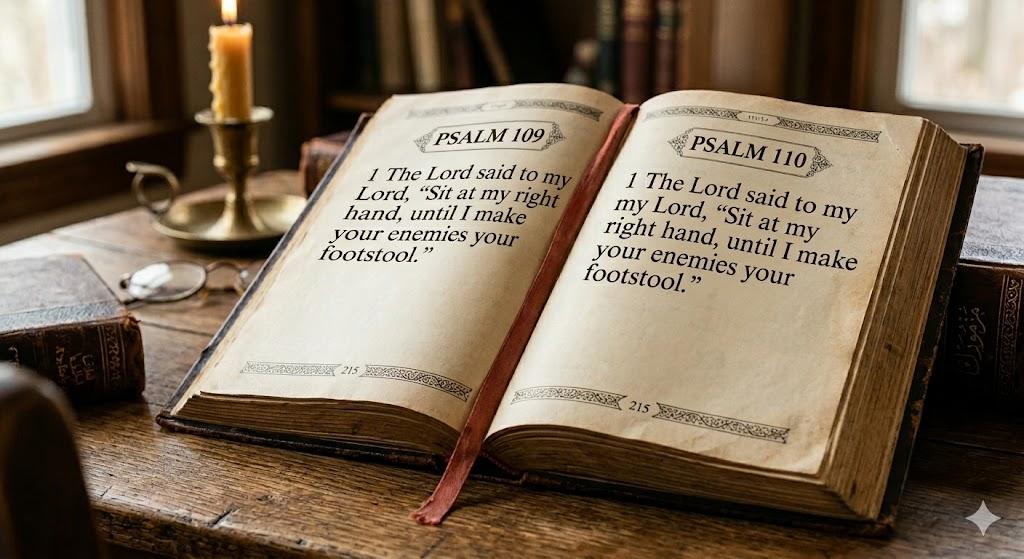
(Psalm 110:1) stands as one of the most pivotal and frequently cited Old Testament verses in the
New Testament. Its brief yet profound declaration, “The LORD says to my Lord: ‘Sit at my right
hand until I make your enemies a footstool for your feet,'” serves as a foundation for Christian
Christology, the doctrine of the Trinity, and the understanding of the Messiah’s dual role as King
and Priest. To fully grasp its weight, one must examine its linguistic nuances, historical context,
and the transformative interpretation provided by Jesus and the early Church.
Historical and Literary Context
Traditionally attributed to King David, (Psalm 110) is classified as a Royal Psalm. In the ancient
Israelite context, these psalms were often composed for significant national events, such as a
coronation or a military victory. However, (Psalm 110) differs from other royal psalms by its overtly
supernatural and prophetic tone. It does not merely celebrate a human king; it points toward a
figure who transcends the typical limitations of the Davidic dynasty.
The Linguistic Nuances: Yahweh and Adoni
The primary key to unlocking the verse lies in the Hebrew text. The phrase translated as “The
LORD says to my Lord” is “Ne’um Yahweh l’Adoni.”
Term Hebrew Meaning
The LORD Yahweh The proper name of the God of Israel (The Father).
My Lord Adoni A title of honor and authority (The Messiah).
In this divine dialogue, Yahweh addresses a figure whom David calls “my Lord” (Adoni). For
David, the King of Israel and the highest human authority in the land, to call someone else
“Lord” implies that the recipient of this address is superior to David himself. This linguistic
structure sets the stage for the Messianic interpretation that would follow centuries later.
Jesus’ Interpretation and Divine Claim
The significance of (Psalm 110:1) reached its zenith in the Gospels, particularly during a
confrontation between Jesus and the Pharisees (Matthew 22:41–46). Jesus asked them a
pointed question: “What do you think about the Messiah? Whose son is he?” When they
responded that he was the “son of David,” Jesus quoted (Psalm 110:1) to challenge their limited,
purely political understanding of the Messiah.
Jesus argued that if the Messiah were merely a human descendant of David, David would not
have addressed him as “Lord” under the inspiration of the Holy Spirit. By quoting this verse,
Jesus was asserting that the Messiah is not only David’s son (humanity) but also David’s Lord
(divinity). This served as a subtle yet powerful claim to His own deity and His pre-existent
relationship with the Father.
Theological Significance: King and Priest
Beyond the first verse, (Psalm 110) introduces another radical concept in verse 4: “The LORD
has sworn and will not change his mind: ‘You are a priest forever, in the order of Melchizedek.'”
This is crucial because, in the Levitical system, the offices of King (from Judah) and Priest (from
Levi) were strictly separated. The figure in (Psalm 110), however, holds both offices.
● The Session at the Right Hand: The command to “sit at my right hand” signifies the
highest place of honor, authority, and shared rule with God.
● The Order of Melchizedek: This indicates a priesthood that predates and supersedes
the Aaronic priesthood, emphasizing that the Messiah’s work is eternal and universal.
● Victory over Enemies: The “footstool” imagery represents the ultimate triumph of God’s
Kingdom over sin, death, and all opposing powers.
Conclusion
(Psalm 110:1) is more than a coronation hymn; it is a prophetic window into the nature of Christ. It
bridges the gap between the Old Testament promise and the New Testament fulfillment. By
identifying the Messiah as the one who sits at the right hand of God, the verse provides a
framework for understanding the exaltation of Jesus after His resurrection. It remains a central
text for believers, affirming that the one who was born in the line of David is the eternal Lord of
all, reigning until every enemy is brought under His feet.