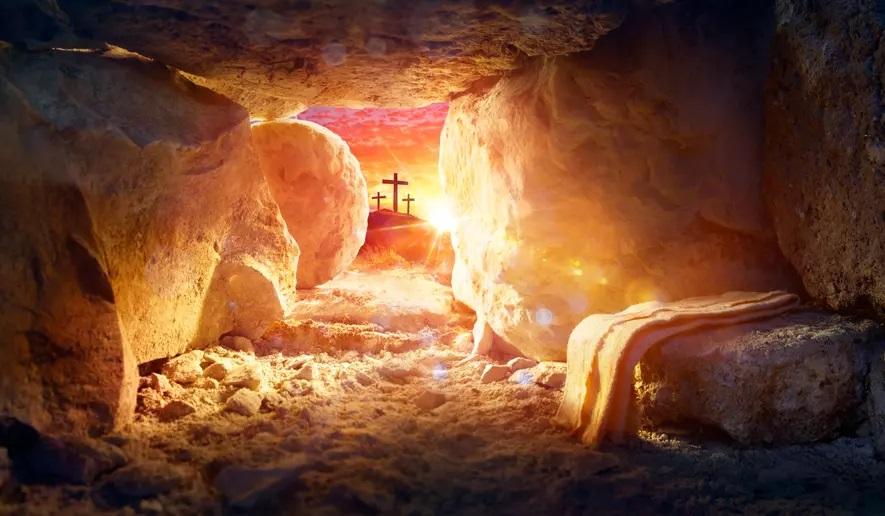
In the history of human civilization, no event has stirred as much controversy and transformation as the “Resurrection of Jesus Christ.” For the believer, it is the cornerstone upon which the entire structure of faith stands. For the historian, it is the घटना that overturned the balance of the Roman Empire. For the philosopher, it is the ultimate challenge to the concept of “death” as an inevitable end. It is not merely a religious doctrine recited in liturgies; rather, it is an “apologetic fact” that confronts the logic of the mind before it touches the depths of the heart.
First: The Crisis of the “Cross” and the Explosion of the “Resurrection” (Historical Context)
The story begins with a scene of total defeat: a cross, a sealed tomb, and scattered disciples filled with fear. Logically, the “Christian movement” should have ended with the death of its leader, as happened with many Jewish revolts of that era. Yet what occurred was the exact opposite. Christianity emerged from Jerusalem—the very city where Christ was crucified—with a power that cannot be explained except by a “supernatural” event that broke the barrier of death.
The Apostle Paul states with decisive clarity: “And if Christ has not been raised, our preaching is useless and so is your faith” (1 Corinthians 15:14). Here, Christianity places its entire credibility on a single “historical fact”: Did Christ truly rise?
Second: The Apologetic Case… Evidence That Cannot Be Dismissed
In apologetics, we rely on the method of “inference to the best explanation.” There are three historical facts acknowledged even by non-believing historians, and the Resurrection is the only explanation that coherently unites them:
The Mystery of the Empty Tomb:
The opponents of Christianity (Jews and Romans) were never able to produce Christ’s body to silence the proclamation of the Resurrection. Had the body been available, Christianity would have died in its cradle. The “stolen body” theory collapses in light of the presence of a heavily guarded Roman watch, as well as the psychological state of the disciples, who were so broken and fearful that they would not have been capable of confronting an elite unit of the Roman army.
The Embarrassing Testimony of Women:
In the first century, a woman’s testimony was considered weak or legally unacceptable. If the story were a fabricated myth, it would have been logical to claim that “Peter” or the “high priest” discovered the tomb. Yet the Gospels insist that Mary Magdalene and other women were the first witnesses. This “historical embarrassment” is a powerful indication of the authenticity of the account.
Post-Resurrection Appearances:
The Resurrection was not a subjective vision experienced by one individual. Christ appeared to individuals (Peter, James), to groups (the Twelve), and to a large crowd (more than 500 people). Paul writes: “After that, he appeared to more than five hundred of the brothers and sisters at the same time, most of whom are still living” (1 Corinthians 15:6). Paul’s statement was essentially an open challenge: “Go and ask them—they are still alive.”
Radical Transformation (From Fear to Martyrdom):
People may die for something they believe to be true, but no one dies for a lie they know they invented. The disciples who denied Christ at the crucifixion later faced death and torture with boldness for the sake of proclaiming the Resurrection. What changed them? There is no explanation except that they “saw the risen Lord.”
Third: The Resurrection Confronting Materialist Philosophy
The Resurrection shatters the tyranny of nihilism. Materialist philosophy views the human being as nothing more than chemical matter destined to decompose, but the Resurrection introduces the concept of the “glorified spiritual body.” Christ did not rise as a mere illusion or ghost; He rose with a real body (He ate with them and was touched), yet a body no longer subject to the laws of decay and corruption.
“It is sown in dishonor, it is raised in glory; it is sown in weakness, it is raised in power” (1 Corinthians 15:43).
Fourth: The Theological and Spiritual Significance (Why Do We Need the Resurrection?)
Divine Justification:
The Resurrection is God’s “signature” on the work of Christ. It is the declaration that the sacrifice of the cross has been accepted and that the debt has been paid.
“He was delivered over to death for our sins and was raised to life for our justification” (Romans 4:25). Without the Resurrection, the cross remains a tragic, but with the Resurrection, it becomes a redemptive victory.
The Defeat of Death’s Power:
Death is humanity’s greatest enemy, and the Resurrection is the official declaration of its defeat. Christ, as the “firstfruits of those who have fallen asleep,” has opened the way for every believer to share in the same resurrection.
“Where, O death, is your sting? Where, O grave, is your victory?” (1 Corinthians 15:55).
A Living Hope Amid Suffering:
For the Christian, the Resurrection guarantees that pain does not have the final word. It reshapes the meaning of suffering; every cross in the believer’s life carries within it the promise of an approaching dawn.
Fifth: The Resurrection as a Force for Social and Cultural Change
The Resurrection was not a “private” event; it sparked a revolution in values. The early Church, grounded in the belief in the Resurrection, practiced unprecedented principles: equality between master and slave, between man and woman, and care for the poor and the sick—those whom pagan society despised. The Resurrection bestowed a “sacred” value on the human body and human life, declaring that humanity is called to eternal glory.
Conclusion: A Call to Experience, Not Mere Observation
In the end, the Resurrection of Christ remains the greatest event in the records of time. It transcends history to become a personal call to every individual. It places us before two choices: either Christ is the “Son of God” who conquered death, or history has been built upon the greatest deception in existence.
Yet the evidence of the empty tomb, the transformed lives of millions across the ages, and the endurance of faith under the harshest persecutions all affirm one truth proclaimed long ago by the angel:
“He is not here; He has risen, just as He said!” (Matthew 28:6).
The Resurrection is the great divine “Yes” in the face of every “No” uttered by death or despair. It is the strongest apologetic proof, the deepest spiritual consolation, and the unfailing promise that “life” has triumphed in the end.